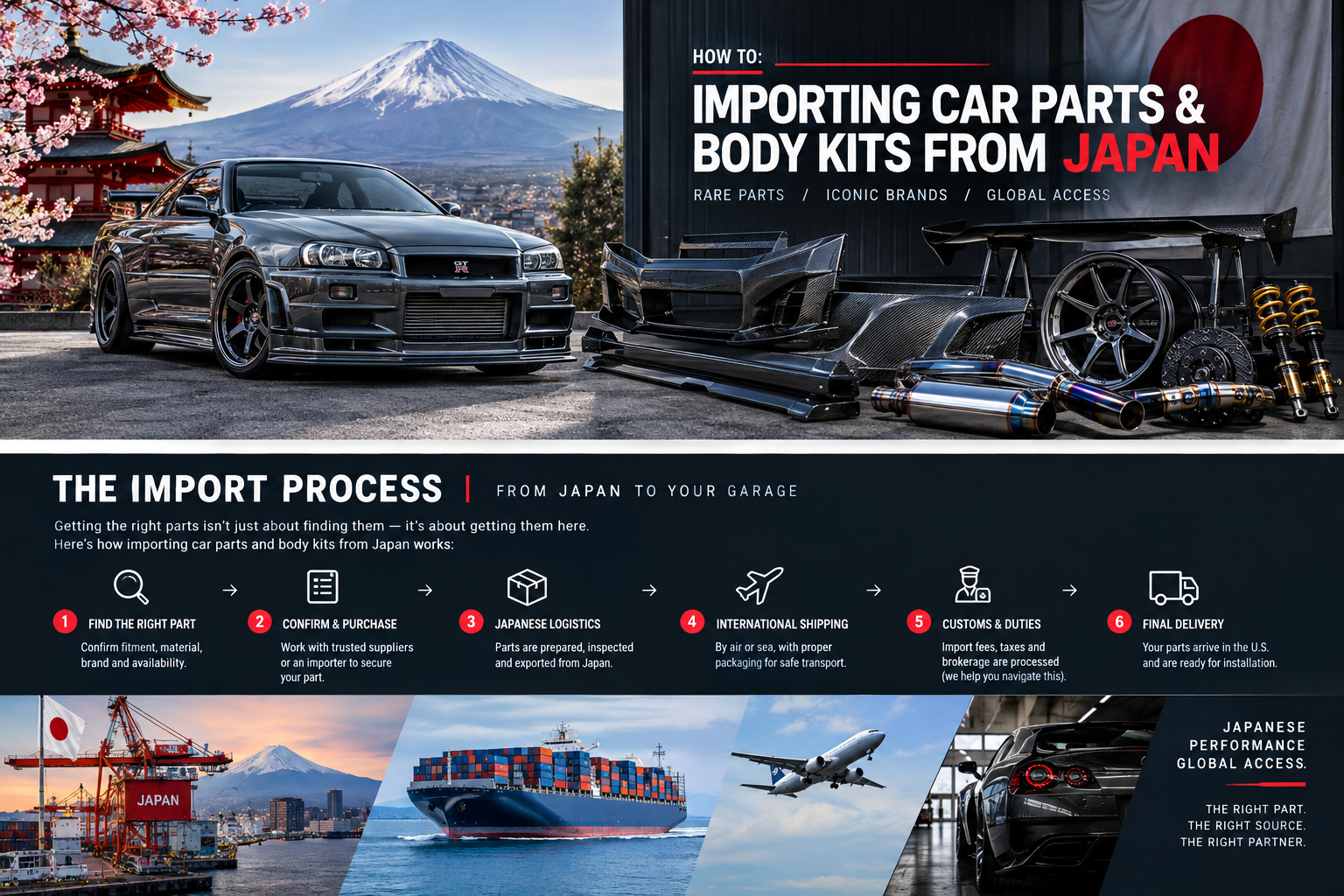
For serious automotive enthusiasts, some of the most desirable performance parts, aero kits, wheels, exhaust systems, suspension components, and body kits simply aren’t available through the typical U.S. aftermarket.
Japan is home to some of the world’s most respected performance manufacturers and tuning companies. From iconic JDM brands to small specialty manufacturers producing limited-run components, importing directly from Japan can open the door to parts that are difficult—or sometimes impossible—to find domestically.
But importing high-end automotive parts isn’t quite as simple as clicking “buy” and waiting for a package to arrive. Large body kits, fragile carbon-fiber components, oversized aero pieces, and expensive performance parts require careful attention to sourcing, shipping, customs, fitment, and import costs.
Here’s what you need to know before bringing your next Japanese performance part into the U.S.
1. Find the Right Part and Manufacturer
The first step is identifying exactly what you want.
Japan has an enormous aftermarket, and two parts that appear similar online can differ significantly in materials, construction, fitment, and quality. This is especially important with body kits and aerodynamic components.
Before ordering, verify:
The exact make, model, and year of your vehicle
Whether the part is designed for your specific chassis
Left-hand-drive or right-hand-drive compatibility where applicable
Material construction, such as FRP, fiberglass, carbon fiber, or polyurethane
Whether the part is an original manufacturer’s product or a replica
Whether hardware and mounting brackets are included
Whether the manufacturer still produces the part
Estimated production and delivery time
For rare or discontinued components, availability can change quickly. A reputable importer or sourcing specialist can often help locate parts through Japanese manufacturers, distributors, specialty shops, and private inventory.
2. Understand That “Available” Doesn’t Always Mean “In Stock”
One of the biggest surprises for first-time importers is discovering that a part listed online may not actually be sitting on a warehouse shelf.
Many Japanese performance companies manufacture products in relatively small quantities. Some body kits and specialty components are made to order.
That means your order may go through several stages:
Order → Manufacturer confirmation → Production → Quality inspection → Export preparation → International shipping → U.S. customs → Final delivery
A high-end body kit may therefore take considerably longer than a conventional aftermarket part purchased domestically.
If you’re building a car around a specific event, show, or deadline, plan accordingly.
3. Shipping Is a Major Part of the Equation
Shipping a small performance component from Japan can be relatively straightforward.
A full body kit is a completely different story.
Large bumpers, side skirts, spoilers, hoods, diffusers, and other aerodynamic components can require oversized or freight shipping. The dimensions of the package—not just its weight—can have a significant impact on transportation costs.
Some parts may be shipped by air for speed, while larger or heavier shipments may make more sense by sea freight.
For particularly valuable or fragile parts, proper packaging is critical. Carbon-fiber panels and painted or finished aero components can be damaged if they’re not packed appropriately for international transportation.
This is one reason working with an experienced importer can be valuable. The cheapest shipping option isn’t necessarily the best option when you’re dealing with a $5,000+ body kit.
4. Don’t Forget Import Duties and Fees
The purchase price isn’t necessarily the final cost of an imported part.
Depending on the product, its classification, country of origin, declared value, and other factors, your shipment may be subject to customs duties, taxes, brokerage charges, and other fees.
The exact treatment can vary from one product to another, so it’s important to determine the expected landed cost before committing to a purchase.
Think in terms of landed cost, rather than simply the price listed by the Japanese seller.
Your total investment may include:
Part cost + domestic Japanese shipping + export handling + international freight + insurance + customs duties/fees + brokerage + domestic delivery
Getting this number upfront can prevent an unpleasant surprise when the shipment reaches the United States.
5. Make Sure the Part Is Correct for Your Car
This is particularly important with Japanese-market vehicles and internationally produced performance parts.
Even when two vehicles share the same chassis designation, there can be differences between Japanese-market and U.S.-market versions.
There may also be changes between model years, facelifts, special editions, and different trim levels.
Body kits are especially unforgiving. A bumper that looks like it should fit may require different brackets, lighting components, grilles, or modifications.
Before purchasing, confirm fitment with the manufacturer or an experienced importer.
A few minutes of research before the order can save thousands of dollars and countless hours after the part arrives.
6. Be Careful With Replicas and Counterfeit Parts
The popularity of Japanese performance products has also created a market for replicas and counterfeit parts.
If you’re investing in a premium body kit or performance component, knowing exactly what you’re purchasing is essential.
A genuine manufacturer’s product can differ substantially from a replica in:
Materials
Weight
Fitment
Construction quality
Finish
Hardware
Structural integrity
Long-term durability
For a high-end build, the difference between an authentic part and a cheap copy can be significant.
Whenever possible, source through established manufacturers, authorized distributors, reputable Japanese suppliers, or an importer with established relationships overseas.
7. Consider Using an Experienced Importer
Technically, you can attempt to manage the entire process yourself.
But importing a $500 replacement part is very different from importing a $10,000 body kit, rare engine component, or collection of specialty performance parts.
An experienced importer can help coordinate the process from beginning to end, including:
Sourcing → Verification → Purchase → Japanese logistics → Export → International freight → Customs → U.S. delivery
The biggest advantage isn’t simply convenience. It’s having someone who understands the potential problems before they happen.
For rare or expensive parts, that experience can be worth far more than the cost of handling the import yourself.
8. Inspect Everything When It Arrives
When your shipment arrives, inspect it carefully before installation.
Look for shipping damage, cracks, scratches, broken mounting points, missing hardware, or other issues.
For expensive components, photographing the packaging and parts immediately upon delivery is a good practice. If there is transportation damage, having documentation can be extremely helpful when dealing with the carrier or insurance provider.
Don’t assume that an international shipment will automatically arrive in perfect condition simply because it was professionally packed.
Why Import From Japan?
Despite the additional considerations, importing directly from Japan can be an excellent way to build something truly unique.
You gain access to manufacturers and products that may never have established a significant presence in the U.S. market.
For enthusiasts building high-end JDM, OEM+, track, street-performance, or show vehicles, that access can make all the difference.
The key is approaching the process correctly.
Do your research. Verify the part. Understand the true landed cost. Plan for shipping. Confirm fitment. And work with experienced professionals when the value or complexity of the shipment warrants it.
The Bottom Line
Importing car parts and body kits from Japan doesn’t have to be complicated—but it does require more planning than buying a part from a domestic retailer.
When you’re dealing with rare, high-value, or oversized performance components, the goal shouldn’t simply be finding the lowest advertised price. The goal is getting the right part, from the right source, delivered safely and efficiently.
For enthusiasts who want access to Japan’s high-end automotive aftermarket, international sourcing can open up an entirely different world of possibilities.
And when the part you’re looking for isn’t available locally, that’s exactly where a knowledgeable import partner can make the difference between a frustrating experience and a successful build.