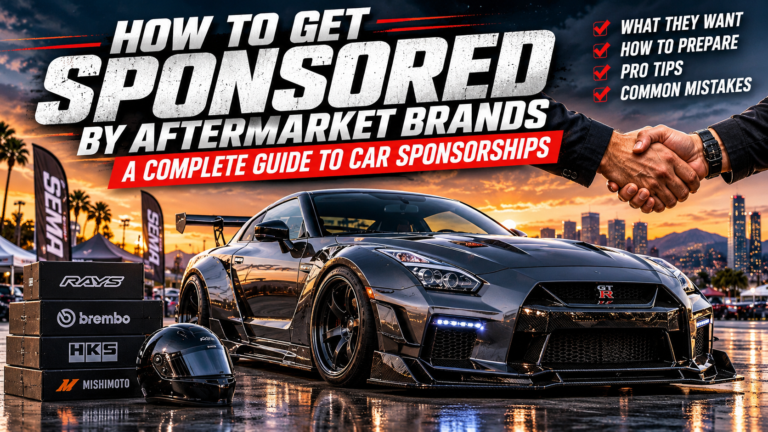
How to Get Sponsored by Aftermarket Automotive Brands: A Complete Guide to Car Sponsorships
Getting sponsored in the automotive aftermarket industry isn’t necessarily as difficult as people make it out to be. However, approaching a manufacturer or retailer the wrong way can make it considerably harder.
One of the biggest misconceptions about sponsorships is that having a large social media following, a nice car, or a willingness to promote a brand is enough to get a company interested. In reality, there’s a lot more to it.
If you’re looking to secure a sponsorship for your build, whether it’s a body kit, wheels, suspension, performance parts, or something else entirely, there are several things you should understand before reaching out to a brand.
Having spent time on the other side of these conversations, I can tell you that the details matter. Here’s what you should be thinking about before sending that first sponsorship email.
Know the Brand & Know Exactly What You Want
This is probably the biggest mistake people make when approaching manufacturers and retailers.
Don’t send a generic email saying something like:
“I’m building a car and looking for a sponsorship. I’m interested in getting a widebody kit. Let me know what you can offer.”
What exactly does that mean? Which manufacturer? Which kit? Which product?
If you’re approaching a particular brand, take the time to educate yourself on its product lineup. Know what you’re interested in, and if possible, identify the exact product or SKU number.
For example, there’s a big difference between saying you’re looking for a widebody kit and saying:
“I’ve been researching your product lineup and am particularly interested in your XYZ widebody kit for my 2021 Nissan GT-R. I’ve reviewed the available options and believe this is the direction I’d like to take my build.”
See the difference?
Manufacturers want to know that you’re genuinely interested in their brand, not simply shopping around for whoever is willing to give you something for free.
There’s nothing wrong with approaching multiple companies, but your outreach should demonstrate that you’ve actually done your homework.
Specificity shows genuine interest. Generic sponsorship requests suggest you’re just looking for a handout.
Focus on What You Can Bring to the Table, Not Just Your Social Media Following
One of the first things people tend to mention in a sponsorship request is their social media following.
“I have 15,000 Instagram followers.”
“I’m growing on TikTok.”
“I get thousands of views on my videos.”
That’s great, but what does it actually mean for the manufacturer?
Unless you have an exceptionally large and engaged audience, follower counts alone aren’t particularly impressive. Even large numbers don’t necessarily translate into sales, meaningful exposure, or brand awareness.
Instead of making your social media following the centerpiece of your sponsorship proposal, focus on what you’re actually going to do with the product and how you’re going to expose the brand to potential customers.
For example, what automotive events are you attending?
Be specific.
- Are you attending SEMA in 2027?
- Have you registered for specific regional automotive shows?
- Is your vehicle already accepted into any competitions or exhibitions?
- Are you planning to participate in organized automotive events throughout the year?
There’s a considerable difference between saying you attend 100 car shows annually and providing an actual list of the events you’re attending.
If you’ve already been accepted into a show, say so. If registration hasn’t opened yet, be upfront about that, too.
Manufacturers want to see a realistic plan, not an exaggerated promise of exposure.
Social media numbers can certainly be helpful, especially when supported by engagement statistics and actual content performance. But don’t assume those numbers are the most important thing you’re bringing to the table.
Be Mindful of the Other Brands Already on Your Vehicle
Something else manufacturers may consider is what other aftermarket products and brands are already represented on your vehicle.
Let’s say you’re approaching a manufacturer for a body kit, but your vehicle already has a competing manufacturer’s front lip, rear wing, hood, and other exterior components.
That might be a problem.
Some brands are particular about who they’re associated with and what other products appear alongside their own. A manufacturer may not want its body kit featured on a vehicle that prominently displays products from a direct competitor.
On the other hand, having an established collection of aftermarket modifications can demonstrate that you’re serious about your build.
Sometimes having a relatively clean vehicle is an advantage. Other times, having an extensively modified vehicle can work in your favor.
The important thing is understanding the brand you’re approaching and considering how your existing modifications might be perceived.
Don’t assume that every manufacturer will appreciate seeing its products alongside every other brand.
Previous Sponsorships Can Help Establish Credibility
If you’re approaching a larger manufacturer for a substantial sponsorship, it helps to demonstrate that you’ve already worked with other companies.
For example, if you’re asking a manufacturer to provide a complete body kit, it certainly helps if you’ve previously secured sponsorships with companies supplying your intake, cooling system, suspension, wheels, or other components.
Why?
Because previous sponsorships demonstrate that you have some experience working with aftermarket brands and understand what’s expected of you.
You already know that sponsorship isn’t simply receiving discounted or complimentary products. There are expectations, responsibilities, and deliverables involved.
Even relatively modest sponsorships can help establish that you’re already participating in the automotive aftermarket community.
If this is your first sponsorship request ever, that doesn’t automatically disqualify you. Everyone starts somewhere.
However, when a manufacturer is considering providing a substantial amount of product, having an established history of working with other brands can certainly make you a more attractive candidate.
Sponsorship Doesn't Always Mean Free Products
Let’s clear up one of the biggest misconceptions about automotive sponsorships: being sponsored doesn’t necessarily mean receiving products for free.
In fact, many sponsorship arrangements involve discounted pricing rather than complimentary products.
Depending on the manufacturer, retailer, and opportunity, you might receive:
- Wholesale pricing.
- Products at or near the manufacturer’s cost.
- Special VIP pricing.
- Discounts of 10%, 15%, 30%, or sometimes considerably more.
- Other negotiated pricing arrangements that aren’t available to the general public.
And honestly, these can be excellent opportunities.
Remember that the products you’re requesting didn’t magically appear. There are real costs associated with developing, manufacturing, importing, distributing, and shipping aftermarket products. There are people involved in every stage of that process, and those expenses don’t disappear simply because someone has a nice car.
A manufacturer has invested time, money, and resources into developing its products. There are employees to pay, production costs to cover, shipping expenses, import costs, and plenty of other overhead.
Occasionally, a manufacturer might provide a product entirely free of charge. It happens. But don’t approach sponsorship with the expectation that someone is going to look at your car and hand you thousands of dollars in complimentary products.
That’s generally not how the industry works.
When someone tells you they’re sponsored, that doesn’t necessarily mean the manufacturer gave them everything for free. They might have received 10% off, 15% off, or even 30% off. They may have negotiated a special arrangement that allows them to purchase products at pricing unavailable to the general public.
That’s still a sponsorship.
In many cases, you’ll be expected to have some skin in the game. From the manufacturer’s perspective, there’s also a level of commitment involved. If someone receives a completely free product, what’s stopping them from turning around and selling it?
A discounted arrangement establishes a mutual investment. You’re saving a substantial amount of money on your build, while the manufacturer receives exposure, brand recognition, and potentially new customers.
In return, you might be expected to regularly feature the brand on social media, tag the manufacturer in your posts, attend automotive events, photograph the products, and help promote the brand throughout your build.
Think of it as VIP pricing in exchange for helping build the brand.
And sometimes, that’s an incredible deal.
Have a Professional Installation Plan
This is particularly important when requesting expensive or complicated products such as body kits.
If a manufacturer is considering providing you with a body kit at a substantial discount or potentially covering the product entirely, they’re going to want some assurance that the finished installation will represent their brand properly.
Who is installing the kit?
Is it an established automotive body shop with experience working on aftermarket vehicles? Do they have experience with the specific type of installation you’re requesting?
Or are you planning to install everything yourself in your driveway?
There’s nothing inherently wrong with DIY projects, but manufacturers have reputations to protect. If a complicated body kit is installed improperly, the finished product may reflect poorly on the manufacturer, even if the problem has nothing to do with the quality of the kit itself.
If you’re using a professional shop, provide its name and some information about its experience. Better yet, provide examples of previous work.
Don’t simply tell a manufacturer that you have a professional installer. Make sure it’s someone who can actually deliver professional results.
The quality of the finished vehicle matters.
Understand Everything That Goes Into Your Build
This is especially important when requesting sponsorships for widebody kits and other extensive modifications.
A widebody kit isn’t necessarily a standalone purchase. Depending on the vehicle and the kit, it may require additional components, modifications, and supporting products to complete the build properly.
For example:
- Have you purchased wheels with the appropriate width and offset?
- Do you have an air suspension system or another suspension solution?
- Have you considered tire sizing and clearance?
- Are there additional modifications required to accommodate the kit?
- Have you accounted for installation and any necessary bodywork?
You’d be surprised how many people approach manufacturers requesting sponsorships for complete widebody kits without having any idea what comes next.
If you’re asking a company to help provide an extensive product, you should already understand what it takes to make that product work.
Imagine being a manufacturer and receiving a sponsorship request for a widebody kit, only to discover that the applicant hasn’t considered wheels, suspension, or any of the other components necessary to complete the project.
It raises questions about whether the person has actually researched the build or understands what they’re getting into.
On the other hand, imagine receiving a request from someone who has already purchased the appropriate wheels, secured an air suspension sponsorship, identified a reputable installation shop, and has a clear plan for completing the vehicle.
That’s a completely different conversation.
Show manufacturers that you’ve thought through the entire project, not just the one product you’re asking them to sponsor.
Have Plenty of Quality Photos of Your Vehicle
This is another area where preparation can make a significant difference.
When approaching a manufacturer, don’t just send one photograph of your vehicle and expect them to make a decision.
Create a Google Drive folder containing a comprehensive collection of photographs.
I’m talking about 50 to 100 photographs if you have them.
Include:
- Exterior photographs from multiple angles.
- Front, rear, and side profiles.
- Interior photographs.
- Engine bay photographs.
- Close-ups of existing modifications.
- Photographs showing the overall condition of the vehicle.
Why is this important?
First, manufacturers want to know what they’re associating their products with. Is the vehicle clean, well-maintained, and presentable? Is it a legitimate build, or is it a vehicle that’s barely holding together?
Second, photographs demonstrate something else: your willingness to document your project.
If you haven’t taken the time to photograph your vehicle before requesting a sponsorship, why should a manufacturer assume you’re suddenly going to become a professional photographer once you receive complimentary products?
Don’t make promises about the content you’re going to produce without demonstrating that you’re already capable of producing it.
A well-organized collection of photographs gives a manufacturer confidence that you’re serious about your vehicle and understand the importance of documenting the build.
Your Driving Experience and Vehicle Responsibility Matter
Here’s something people don’t always consider: manufacturers are also evaluating risk.
If you’re requesting thousands of dollars in aftermarket products, the manufacturer has a legitimate interest in knowing that the vehicle and the products will be taken care of.
Your driving experience can be relevant here.
For example, there’s a difference between someone who just received their driver’s license and someone who has been driving for 15 or 20 years.
If you have a background in organized motorsports, track events, professional driving instruction, or racing certifications, mention it.
These details can help establish that you’re an experienced driver who understands vehicle responsibility.
Age alone shouldn’t determine someone’s suitability for sponsorship, but experience and a demonstrated history of responsible vehicle ownership can certainly help.
A manufacturer doesn’t want to invest in a vehicle that ends up wrecked shortly after the products are installed.
Again, the objective is to give the manufacturer confidence that its investment is going to be protected.
The Bottom Line: Make It Easy for a Manufacturer to Say Yes
If there’s one thing I’d like you to take away from all of this, it’s that approaching a manufacturer for sponsorship should be treated like presenting a business proposal.
Don’t simply tell a company what you want. Show them why they should want to be involved.
Know the brand. Identify the exact products you’re interested in. Explain what you’re bringing to the table. Demonstrate that you’ve thought through the build, have a professional installation plan, and have the experience and resources to follow through.
Understand that sponsorship doesn’t always mean free products. A substantial discount or special wholesale arrangement can be just as valuable, particularly when it helps you build a vehicle you might not otherwise be able to afford.
Most importantly, don’t rely on promises.
Anybody can promise to post photographs, attend car shows, promote products, and generate exposure. What separates a serious sponsorship candidate from everyone else is the ability to demonstrate that they’re already doing those things.
Manufacturers and retailers receive sponsorship requests all the time. Many of those requests are generic, poorly prepared, and lack the information necessary to make an informed decision.
Your goal is to stand out for the right reasons.
Don’t approach a manufacturer expecting them to invest in your project. Approach them with a project that gives them a reason to invest.